API Gateway vs Reverse Proxy Explained with Real Use Cases
I’m a senior full-stack developer working across system design, DevOps, and AI. I build scalable systems, optimize performance, and explore emerging tech. I’ve written “Machine Learning in iOS” and am now writing a new book on system design, DevOps, and ML. This blog is where I share what I learn, build, and discover.
When I first came across API Gateway and Reverse Proxy, I assumed they were the same thing. They aren’t — and understanding the difference is crucial for designing a clean, secure, and scalable backend architecture.
Choosing the wrong one can lead to problems like harder debugging, increased latency, broken routing logic, and even authentication leaks.
Here’s a clear breakdown of how they differ:
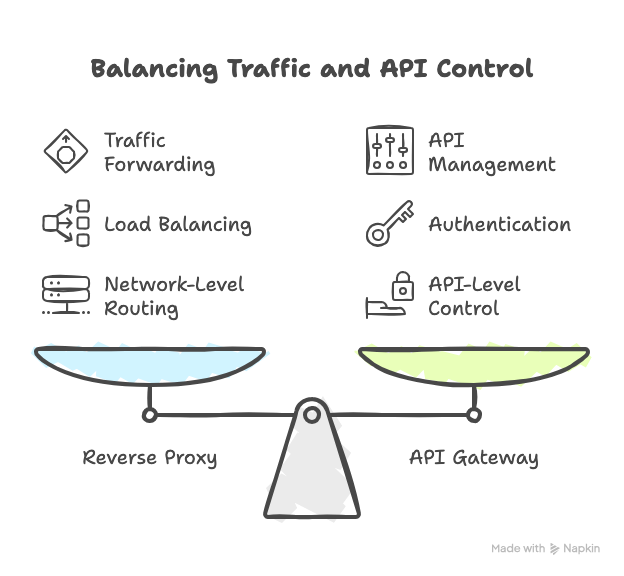
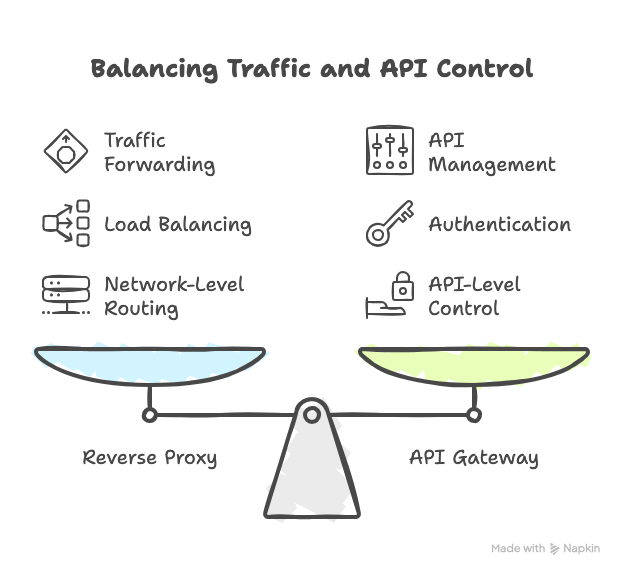
| Feature | Reverse Proxy (e.g., Nginx) | API Gateway (e.g., Kong, AWS API Gateway) |
| Purpose | Forwards traffic to backend servers | Manages, secures, and controls APIs |
| Common Use | Load balancing, SSL termination | Authentication, rate limiting, monitoring |
| Scope | Network-level routing | API-level policy and control |
A Reverse Proxy primarily simplifies internal traffic management — routing requests to the right backend servers and handling things like SSL termination or caching.
An API Gateway, on the other hand, operates at the API layer. It adds capabilities like authentication, throttling, observability, and versioning — acting as a policy enforcement layer between clients and backend services.
For example, in one of our projects, we initially exposed internal microservices directly to the client. Managing versioning and rate limits became difficult, and maintaining consistency across APIs was a nightmare.
The fix was simple but effective:
Place an API Gateway in front to handle authentication, rate limits, and routing.
Use a Reverse Proxy internally to manage load balancing among backend services.
Key takeaway:
Reverse Proxy → Routes traffic efficiently.
API Gateway → Controls traffic with rules and policies.
In distributed systems, you’ll often need both — the proxy to optimize internal routing and the gateway to secure and manage external API access.
Mini Challenge
Draw an architecture diagram using both components in a microservice system.