

Circuit Breakers & Bulkheads
How to stop one failing service from taking down your entire system
I’m a senior full-stack developer working across system design, DevOps, and AI. I build scalable systems, optimize performance, and explore emerging tech. I’ve written “Machine Learning in iOS” and am now writing a new book on system design, DevOps, and ML. This blog is where I share what I learn, build, and discover.
The problem
In distributed systems, failures don’t stay local.
One slow dependency → thread pools fill
→ retries amplify traffic
→ upstream services stall
→ the outage spreads.
This is called a cascading failure.
Large-scale platforms at companies like Netflix and Amazon design their systems assuming:
dependencies will fail.
One-line definition
Circuit breaker prevents calling a broken dependency.
Bulkhead prevents a broken dependency from consuming all your resources.
They solve two different failure modes.
The mental model
When a dependency becomes unhealthy:
stop sending traffic to it
isolate its resource usage
allow the rest of the system to survive
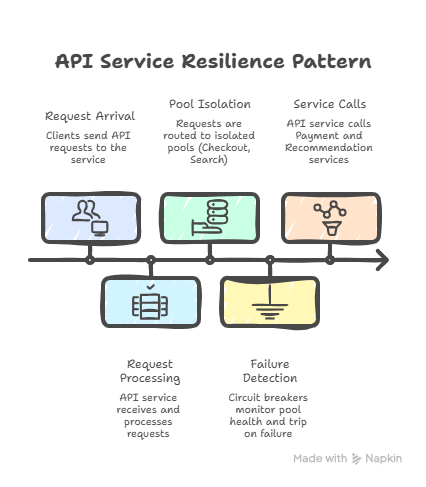
Single system view
Clients
   |
   v
+----------------------+
|     API Service      |
+----------------------+
   |             |
   |             |
   v             v
+---------+   +---------+
| Pool A  |   | Pool B  |   <-- Bulkheads (isolated resources)
+---------+   +---------+
    |             |
    v             v
+-----------+  +-----------+
| Service X |  | Service Y |
+-----------+  +-----------+
      |
      v
[CIRCUIT BREAKER]
      |
      v
 Downstream Dependency
Circuit breaker – what actually happens
A circuit breaker has three states:
Closed
→ traffic flows normally
Open
→ requests are rejected immediately
→ no network calls
→ no threads blocked
Half-open
→ a small number of test requests
→ decide if recovery is real
Why this matters:
Fail fast is better than fail slowly.
Slow failures:
keep threads busy
hold sockets
amplify retries
Bulkheads – the other half of the story
Bulkhead means:
One dependency must not consume resources needed by others.
Typical bulkheads:
separate thread pools
separate connection pools
separate queues
Without bulkheads:
A single slow downstream can exhaust:
worker threads
database connections
event loops
And your healthy features die with it.
Circuit breaker vs timeout vs retry
Timeout:
→ limits how long you wait.
Retry:
→ increases pressure during failure.
Circuit breaker:
→ stops useless traffic entirely.
If you retry without a breaker,
you are helping the outage spread.
Real-world example
Think about a typical media or commerce backend:
API
→ personalization service
→ recommendations service
→ payments service
If recommendations become slow:
You do NOT want:
checkout threads waiting on recommendations.
With bulkheads:
checkout has its own pool
recommendations can fail independently
With a circuit breaker:
the system quickly skips recommendations
a fallback is served
This failure isolation pattern is widely used in large production systems, including those at Netflix scale.
The most common mistake
Only adding circuit breakers.
Without bulkheads:
Even when the breaker opens,
the damage is already done:
thread pools are exhausted
request queues are full
memory pressure is high
Circuit breakers protect dependencies.
Bulkheads protect your own service.
You need both.
Advanced consideration: shared pools are dangerous
A single global thread pool is a hidden coupling.
If:
dependency A stalls
it occupies most threads
Then:
dependency B becomes slow
even if B is perfectly healthy
Isolation is more important than efficiency under failure.
Design checklist
Before shipping any microservice:
Does every remote dependency have a circuit breaker?
Does each major dependency have its own thread / connection pool?
Do you have fallbacks when the breaker is open?
Are retries disabled or heavily limited when a breaker is open?
Are critical paths isolated from best-effort features?
Key takeaways
Cascading failures are the default in distributed systems
Circuit breakers stop useless traffic to broken dependencies
Bulkheads prevent one dependency from consuming all resources
Isolation is more important than peak efficiency


