

Offline-First Architecture: Where Sync Conflicts Destroy UX
(Hard Lessons I Learned While Building a Collaborative SaaS)
I’m a senior full-stack developer working across system design, DevOps, and AI. I build scalable systems, optimize performance, and explore emerging tech. I’ve written “Machine Learning in iOS” and am now writing a new book on system design, DevOps, and ML. This blog is where I share what I learn, build, and discover.
While working as a senior architect on an offline-capable collaboration and task management platform, I learned a painful truth:
Offline-first is easy to demo.
Sync is where products die.
The app works perfectly on a flight.
Notes save locally.
Tasks update instantly.
Then the user reconnects.
And everything breaks.
1️⃣ Offline-First Is a UX Promise, Not a Feature
When you say offline-first, users assume:
Their data is safe
Their changes won’t be lost
Conflicts will “just work”
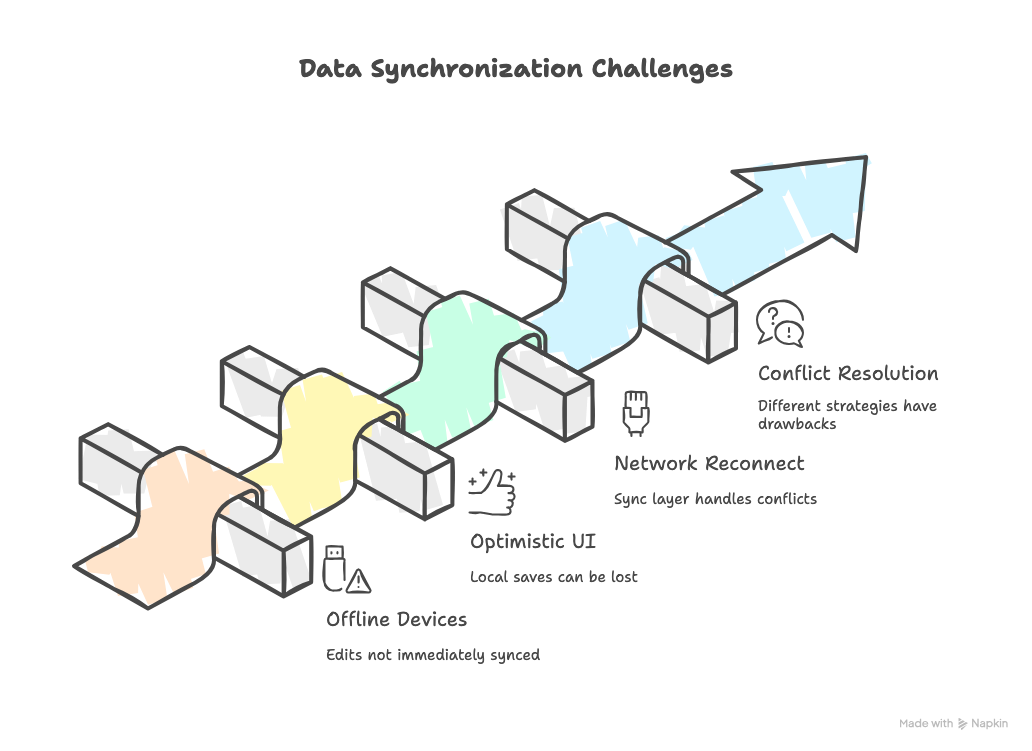
But offline mode creates parallel realities:
Device A edits task title
Device B edits task status
Server has an older version
Now what?
There is no “correct” answer — only tradeoffs.
2️⃣ Sync Conflicts Are Inevitable
Most teams try to avoid this truth.
Reality:
Networks partition
Devices go offline
Users multitask across devices
If your system allows:
Multiple writers
Concurrent edits
Local persistence
👉 Conflicts are guaranteed
The only question is:
How visible will they be to users?
3️⃣ Last-Write-Wins Destroys Trust
The most common approach:
“Just overwrite with the latest timestamp.”
This works… until it doesn’t.
Example:
User edits a long note offline
Comes back online
Another small change overwrites it
Half their work is gone
No error.
No warning.
Just missing content.
Nothing destroys trust faster than silent data loss.
4️⃣ Merges Are Harder Than They Look
Developers think:
“We’ll merge fields”
“We’ll merge JSON”
“We’ll diff objects”
But UX reality:
Text merges create broken sentences
Task state merges create invalid flows
Partial merges confuse users
A technically correct merge can still be a UX disaster.
5️⃣ Conflict Resolution Is a Product Decision
This was a big realization for us.
Conflict handling is not:
A backend-only problem
A database concern
A sync algorithm choice
It’s a product experience decision.
Questions you must answer:
Do users see conflicts?
Can they undo merges?
Which actions are authoritative?
Is collaboration optimistic or conservative?
6️⃣ CRDTs and OT Are Not Silver Bullets
CRDTs and Operational Transforms help — but:
They increase complexity
They raise storage costs
They are hard to debug
They don’t solve all conflicts
They solve data convergence, not user understanding.
A converged state can still feel wrong.
7️⃣ Background Sync Fails Quietly
Another silent UX killer:
App resumes
Sync starts silently
One request fails
Retry never happens
User thinks:
“Everything is saved.”
But it isn’t.
Without:
Sync status indicators
Error visibility
Retry transparency
Offline-first becomes offline-lost.
8️⃣ The UX Cost of “Magic Sync”
The more you hide sync mechanics:
The harder it is to explain failures
The more users blame themselves
The more support tickets you get
Sometimes the best UX is:
“We couldn’t merge this. Please choose.”
Clarity beats magic.
Key Lessons We Took Away
Conflicts are normal — design for them
Silent overwrites are unacceptable
Users need visibility, not cleverness
Sync state is part of UX
Offline-first increases responsibility, not simplicity
Final Thought
Offline-first makes your product feel fast.
Sync determines whether it’s trustworthy.
If users don’t trust their data,
no amount of performance matters.
Offline-first isn’t about working without the internet.
It’s about earning trust when the internet comes back.


